Diamond Basics
How Are Diamonds Formed? From Deep in the Earth to the Laboratory
Natural diamonds formed 150–200 kilometres below the surface, a very long time ago. We explain that journey and how the same crystal is grown in a laboratory today.
3 min readUpdated: October 7, 2026
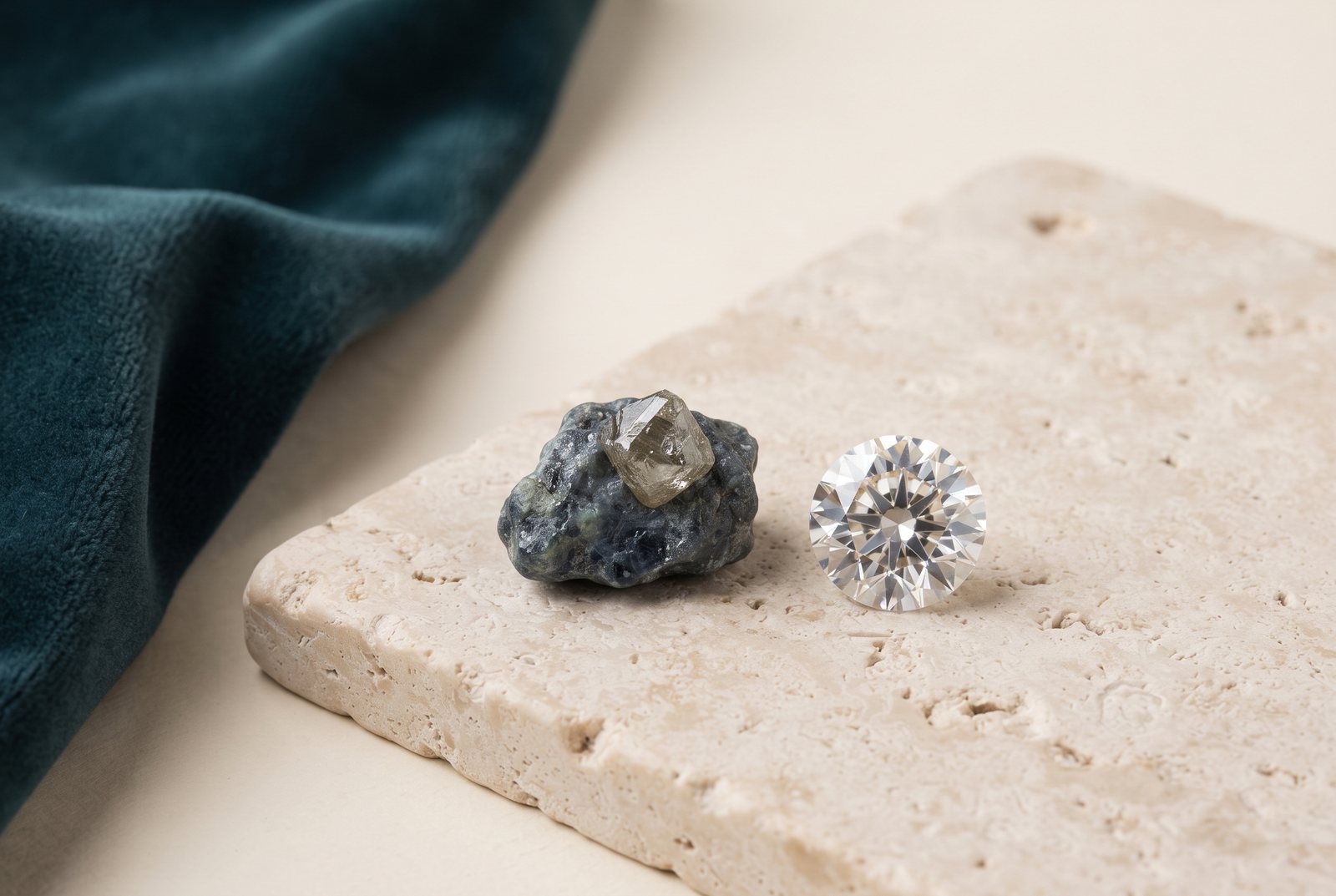
Short answer: A natural diamond forms about 150–200 kilometres below the surface, under very high pressure and temperatures above 1,000 °C, as carbon atoms pack tightly together. Most known natural diamonds are more than a billion years old; they were carried up to rocks near the surface by deep-source volcanic eruptions. Today the same crystal can be grown in a laboratory within weeks, either by recreating these conditions or by building it up layer by layer from gas.
Deep in the earth: natural formation
On the surface, carbon is soft and black as graphite. But deep in the earth, in the mantle, the pressure rises to tens of thousands of times that of the atmosphere. At this pressure and temperature, carbon atoms line up in the tightest and most orderly way, in a cubic crystal structure: a diamond crystal forms. The same carbon, simply arranged differently, turns from graphite into the hardest known natural material.
The journey to the surface: kimberlite
Diamonds form deep down, but they cannot rise to the surface on their own. They are carried by special volcanic eruptions that come from very deep and rise very fast. The carrot-shaped pipes of rock these eruptions leave behind are called kimberlite. Most diamond mines are in these pipes, or in river beds where wind and water carried and deposited the diamonds. When tonnes of rock are processed and sorted, only a very small amount of gem-quality diamond comes out.
From mine to jewellery
- Extraction and sorting: The rock is crushed and the diamonds are separated.
- Classification: The rough stones are sorted by size, colour and clarity.
- Planning and cutting: The cut that will get the most beautiful and largest diamond out of the rough is planned; the stone is cut and polished.
- Grading: Independent laboratories assess the stone on the 4Cs. What are the 4Cs?
- Jewellery: The stone is set in its mounting in the workshop.
Formation in the laboratory
Scientists have found two ways to recreate the conditions in which diamonds form:
- HPHT (high pressure, high temperature): The pressure and temperature deep in the earth are recreated with large presses; carbon crystallises on a diamond seed.
- CVD (chemical vapour deposition): A carbon-containing gas is turned into plasma, and carbon atoms settle layer by layer onto the seed.
Both ways produce a real diamond with the same crystal structure, hardness and light as a natural diamond. The only differences are where it forms and how long it takes: weeks instead of millions of years. CVD versus HPHT · What is a lab-grown diamond?
The same crystal, a different journey: natural and lab-grown diamonds cannot be told apart with the naked eye. The difference is found in gemmological laboratories by looking at the stone’s growth patterns, and it is written on the report. Can testers tell the origin?
Why does it matter?
Knowing how diamonds form helps you understand two things: why natural diamonds are rare and expensive, and why lab-grown diamonds are more affordable although they are the same stone. With this knowledge you can decide more easily which suits you. Should you buy a lab-grown diamond?
Frequently asked questions
A natural diamond forms when carbon crystallises about 150–200 km below the surface under high pressure and temperature. A lab-grown diamond is grown by recreating these conditions or by growing it from gas. The formation of natural diamonds and their journey to the surface are very long geological processes; most known diamonds are more than a billion years old. In a laboratory, a diamond is grown within a few weeks. Natural diamonds are mined from volcanic rock pipes called kimberlite and from river beds where diamonds were carried and deposited. Yes. Both are pure carbon; only the arrangement of their atoms differs. That difference makes graphite soft and diamond the hardest natural material.How do diamonds form?
How long does it take for a diamond to form?
Where do diamonds come from?
Are graphite and diamond made of the same material?
Blog
Keep reading

Diamond Basics
What Do F, G and H Colour Diamonds Mean?
The diamond colour scale runs from D to Z. We explain the difference between E, F, G and H colour stones, whether you can…
3 min read
Diamond Basics
Diamond Sparkle: What Are Brilliance, Fire and Scintillation?
A diamond's sparkle comes from three separate light effects: brilliance, fire and scintillation. We explain what decides them and what people really mean by…
3 min read
Diamond Basics
Diamond Clarity Scale: From FL to I3
Clarity is how visible the tiny marks inside a diamond are. We explain the FL, IF, VVS, VS, SI and I grades with a…
3 min read
Diamond Basics
Cubic Zirconia vs Diamond: What Is the Difference?
Cubic zirconia looks like a diamond at first glance, but it is a very different stone. We explain the differences in hardness, light, weight…
3 min read