Diamond Basics
Cubic Zirconia vs Diamond: What Is the Difference?
Cubic zirconia looks like a diamond at first glance, but it is a very different stone. We explain the differences in hardness, light, weight and durability, and the first clues you can check at home.
3 min readUpdated: October 7, 2026
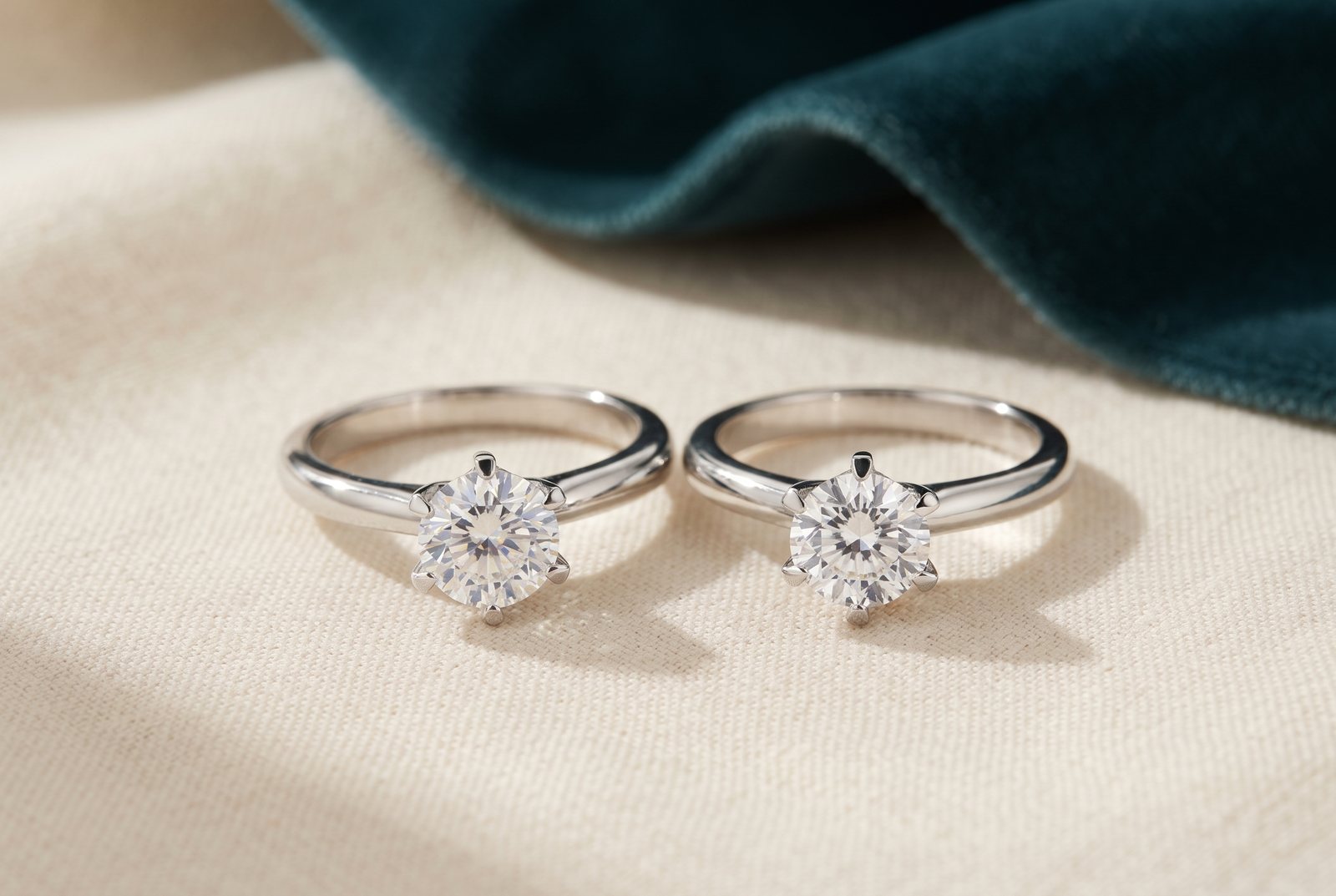
Short answer: Cubic zirconia looks like diamond but is not diamond. Diamond is pure carbon with a Mohs hardness of 10; cubic zirconia is zirconium oxide with a hardness of about 8–8.5. Cubic zirconia gives more coloured fire, bends light less than diamond, is about 1.7 times heavier, and scratches and goes cloudy over time. A diamond keeps the light of its first day even after many years.
What is “zircon”? Two different stones
In everyday Turkish, “zirkon” usually means cubic zirconia: a material made in a laboratory and used to imitate diamond. In nature there is also a separate mineral called “zircon”, which is another stone again. Neither is a diamond. In this article we cover cubic zirconia, the one most often found in jewellery.
Cubic zirconia and diamond compared
| Property | Diamond | Cubic zirconia |
|---|---|---|
| Composition | Pure carbon | Zirconium oxide |
| Hardness (Mohs) | 10 | About 8–8.5 |
| Refractive index | 2.42 | About 2.15–2.18 |
| Coloured fire | Balanced | More, “rainbow-like” |
| Density | 3.52 g/cm³ | About 5.6–6 g/cm³ |
| Thermal conductivity | Very high | Low |
| Over time | Keeps its light | Scratches, goes cloudy |
Clues you can see
- Fire: Cubic zirconia gives more coloured flashes than diamond in light; the “rainbow” effect is especially clear under spotlights. In diamond, white light and coloured fire are more balanced.
- Perfection: Because it is manufactured, cubic zirconia usually has no marks at all and is completely colourless. A flawless, very large but very cheap “diamond” should raise suspicion.
- Wear: On cubic zirconia that has been worn for a while, small scratches and wear show on the edges, and the surface goes dull.
- Weight: At the same size, cubic zirconia is noticeably heavier than diamond; with loose stones, a precise scale shows this.
These clues give a hint but are not conclusive. The way to tell for certain is an instrument and a report.
Telling them apart for certain: tester and report
Diamond conducts heat very well; cubic zirconia does not. Jewellers’ diamond testers measure this difference and identify cubic zirconia within seconds. An independent laboratory report documents both that the stone is a diamond and its origin. How does a diamond tester work? · How to tell if a diamond is real.
A lab-grown diamond is not cubic zirconia: a lab-grown diamond is also made in a laboratory, but it is not an imitation like cubic zirconia; it is a real diamond with the same chemistry, hardness and light as a natural diamond. It tests as diamond on a tester too. What is a lab-grown diamond?
Why diamond?
Cubic zirconia may suit a short-lived fashion piece; but for a solitaire or wedding band that will be worn every day and should keep its light for years, a diamond’s hardness and light are in another league. A lab-grown diamond offers that difference on a more affordable budget. Should you buy a lab-grown diamond?
Frequently asked questions
No. Cubic zirconia is a stone that looks like diamond but is made of a different material (zirconium oxide). It is softer and bends light differently. The stone itself does not darken, but its surface scratches and goes dull, and over time it looks cloudy. A diamond keeps its light because it does not scratch. Home tests are not conclusive. Extra coloured fire and wear on the edges can be clues; for a certain answer you need a jeweller’s tester or a laboratory report. No. Because cubic zirconia does not conduct heat well, it does not show as diamond on a diamond tester.Is cubic zirconia a diamond?
Does cubic zirconia darken over time?
How do you tell cubic zirconia from diamond at home?
Does cubic zirconia test as diamond?
Blog
Keep reading
Diamond Basics
What Do F, G and H Colour Diamonds Mean?
The diamond colour scale runs from D to Z. We explain the difference between E, F, G and H colour stones, whether you can…
3 min read
Diamond Basics
Diamond Sparkle: What Are Brilliance, Fire and Scintillation?
A diamond's sparkle comes from three separate light effects: brilliance, fire and scintillation. We explain what decides them and what people really mean by…
3 min read
Diamond Basics
Diamond Clarity Scale: From FL to I3
Clarity is how visible the tiny marks inside a diamond are. We explain the FL, IF, VVS, VS, SI and I grades with a…
3 min read
Diamond Basics
What Is Diamond Fluorescence? Good or Bad?
Fluorescence is the blue glow some diamonds give off under ultraviolet light. We explain how it appears on the report, whether it affects how…
3 min read