Diamond Basics
Diamond Clarity Scale: From FL to I3
Clarity is how visible the tiny marks inside a diamond are. We explain the FL, IF, VVS, VS, SI and I grades with a table, and which ones look clean to the eye.
3 min readUpdated: October 7, 2026
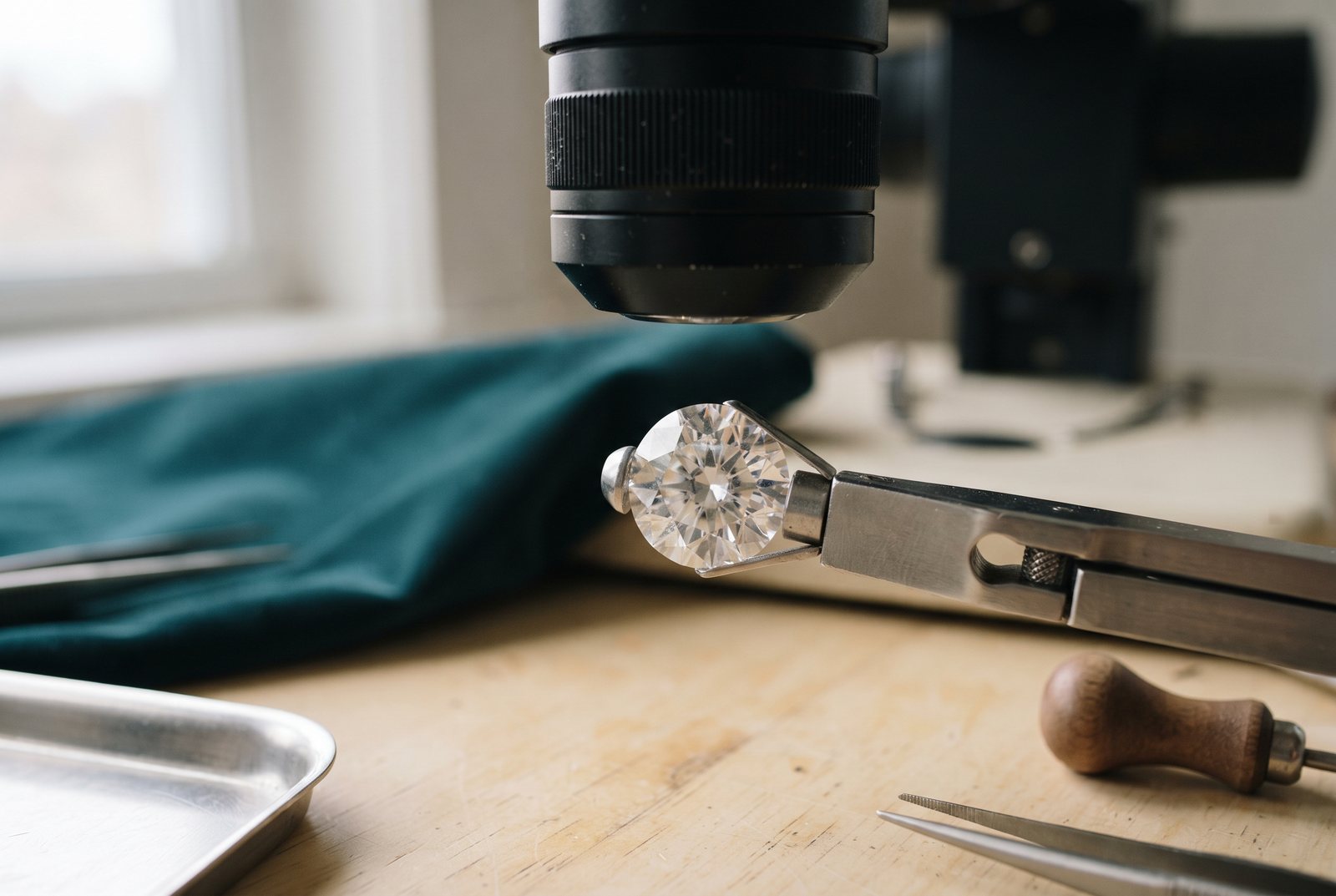
Short answer: The diamond clarity scale, from best to lowest, is: FL, IF, VVS1, VVS2, VS1, VS2, SI1, SI2, I1, I2, I3. Clarity measures how visible the tiny marks inside and on the surface of the stone are under 10x magnification. VS2 and most SI1 stones look clean to the naked eye, which is why this is usually the most balanced range for jewellery.
The clarity scale table
| Grade | Stands for | Meaning |
|---|---|---|
| FL | Flawless | No inner or outer marks at 10x magnification |
| IF | Internally Flawless | No inner marks, only very small surface marks |
| VVS1 – VVS2 | Very Very Slightly Included | Marks very hard to see even under magnification |
| VS1 – VS2 | Very Slightly Included | Small marks under magnification; not visible to the eye |
| SI1 – SI2 | Slightly Included | Noticeable marks under magnification; SI1 is usually eye clean |
| I1 – I3 | Included | Marks may be visible to the eye; can affect brilliance |
What are inclusions?
As diamonds form, tiny crystals, fine cracks called feathers, cloud-like clusters of points or needle-shaped marks can be left inside them. On the surface there can be very small polish marks. These are like the stone’s “fingerprint”; no two stones have the same marks. Lab-grown diamonds have marks too, but they are marks formed in the laboratory (such as very small metallic or dark points), and they are graded on the same scale.
Which clarity is enough?
The real question is “is the stone eye clean?” If no mark can be seen when worn, from a normal viewing distance, the stone is eye clean. Practical suggestions:
- Round and brilliant-style shapes (oval, pear, cushion): VS2 and eye-clean SI1 are the most efficient choice; the sparkle hides marks.
- Step cuts (emerald, baguette, asscher): Because the inside of the stone looks like a window, VS1 and above is recommended. Emerald cut.
- Large stones (2 carats and above): As the stone gets bigger, so do its marks; going one grade higher is a good idea.
- Small side stones (eternity, halo): Because the stones are small, clarity differences cannot be seen.
Where the mark sits matters too
Of two stones with the same grade, the one with its mark near the edge looks cleaner than the one with its mark in the centre, because a mark near the edge is hidden by a prong or by reflections. The plot attached to the report marks where the inclusions are. When choosing a stone, look not only at its grade but also at this plot. How to read a report.
Do not confuse it with “brilliance grade”: in everyday Turkish this scale is sometimes called “brilliance grades”. But clarity measures how visible the marks are, not the stone’s brilliance. Brilliance is decided by the cut. Diamond brilliance.
Effect on price
The higher the clarity, the higher the price; but while the difference between FL and VS2 cannot be seen, it is clear in the price. So keeping clarity at “eye clean” and putting the budget into cut and carat is usually the smartest choice. To consider it together with colour: colour and clarity.
Frequently asked questions
No. The marks at both grades cannot be seen with the naked eye; the difference is only understood under 10x magnification, by an expert eye. No. Most SI1 stones are eye clean and offer good value. It is enough to choose by looking at where the mark is on the report’s plot. FL is very rare and the most expensive grade; the difference can only be seen under magnification. Unless you are collecting or investing, choosing a bigger or better-cut stone with the same budget makes more sense. No. Lab-grown diamonds can have inner marks too and are graded on the same scale; still, a high-clarity stone is often easier to find.Can you see the difference between VVS and VS?
Is an SI1 diamond bad?
Is an FL diamond worth it?
Are lab-grown diamonds always flawless?
Blog
Keep reading
Diamond Basics
What Do F, G and H Colour Diamonds Mean?
The diamond colour scale runs from D to Z. We explain the difference between E, F, G and H colour stones, whether you can…
3 min read
Diamond Basics
Cubic Zirconia vs Diamond: What Is the Difference?
Cubic zirconia looks like a diamond at first glance, but it is a very different stone. We explain the differences in hardness, light, weight…
3 min read
Diamond Basics
Diamond Sparkle: What Are Brilliance, Fire and Scintillation?
A diamond's sparkle comes from three separate light effects: brilliance, fire and scintillation. We explain what decides them and what people really mean by…
3 min read
Diamond Basics
What Is Diamond Fluorescence? Good or Bad?
Fluorescence is the blue glow some diamonds give off under ultraviolet light. We explain how it appears on the report, whether it affects how…
3 min read