Lab-Grown Diamonds
How to Find Your Ring Size: Chart and On-Screen Measuring
Find your ring size at home in three ways: measure a ring you own with the circle on your screen, enter your finger circumference, or look up your size in the chart.
6 min readUpdated: October 7, 2026
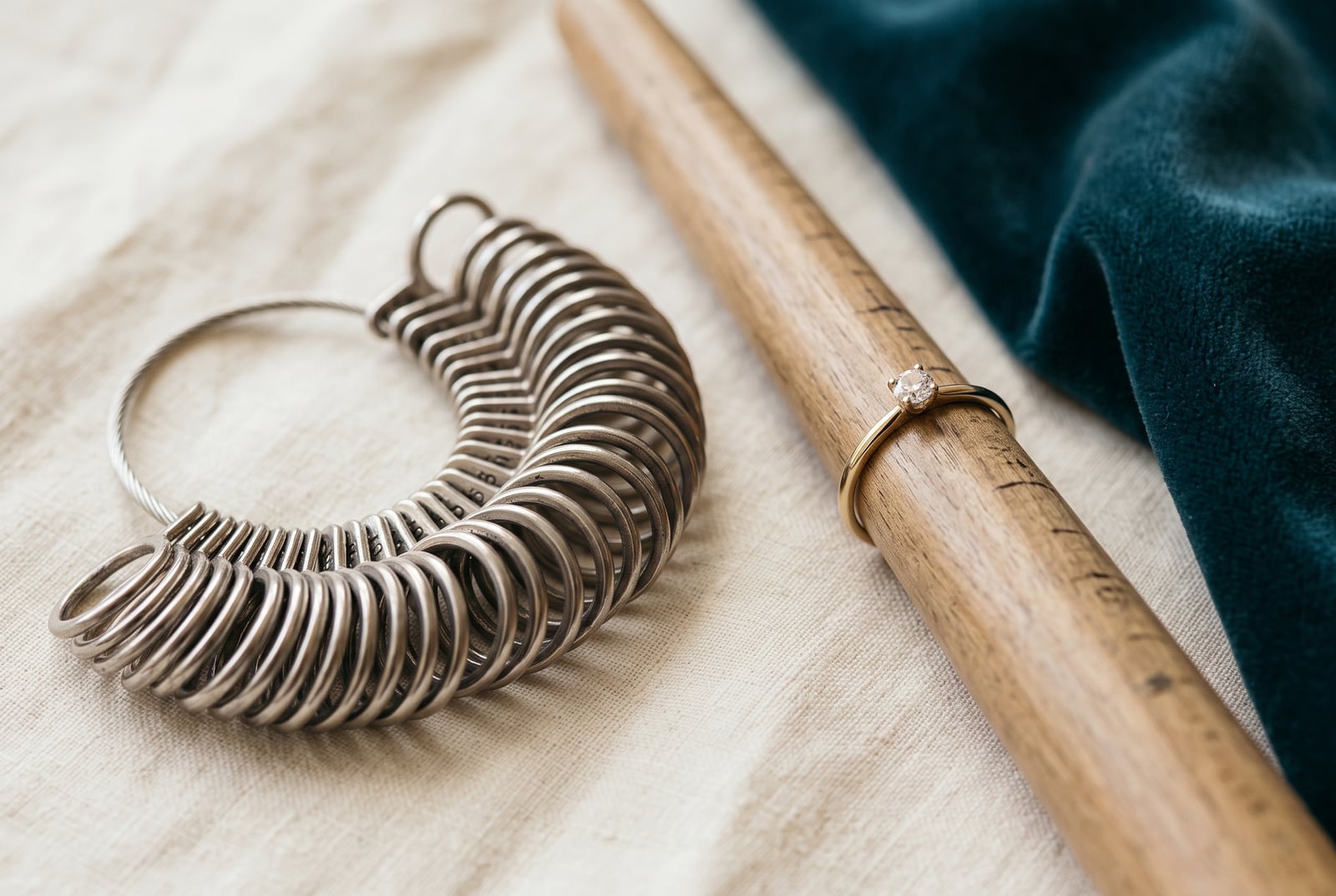
Short answer: Ring size is found from the inner circumference of the ring. The Turkish size number is the inner circumference in millimetres minus 40: a ring with a 52 mm inner circumference is a Turkish 12 (EU 52, about US 6). You can find your size at home in three ways: by measuring a ring you own, by measuring the circumference of your finger, or on screen with the tool below.
Find your ring size on screen
Calibrate your phone or computer screen with a bank card, then place a ring that fits your finger on the circle on the screen. If you know your finger circumference, the second tab shows your size directly.
1. Calibrate the screen. Hold a bank card against the card on the screen; use the slider to make the on-screen card the same width as the real one.
2. Place your ring on the circle. Use the slider to make the circle fill the ring's inner opening exactly.
Wrap a thin strip of paper or a string around the base of the finger. Mark where the ends meet, flatten the strip, measure it with a ruler and enter the millimetres.
This tool gives an approximate result. If you are between two sizes, choose the larger one; to be sure, send us your measurement and we will confirm it together.
How is the ring size calculated?
What determines a ring’s size is its inner circumference, the length of the inner surface that touches your finger. The calculation is simple:
- Turkish size = inner circumference (mm) − 40. A ring with a 52 mm inner circumference is a 12, one with 54 mm is a 14.
- Inner circumference = inner diameter × 3.14. A ring with a 16.6 mm inner diameter has an inner circumference of about 52 mm.
- The EU size is the inner circumference itself: a Turkish 12 is an EU 52.
Three ways to measure at home
1. With a ring you own
This is the most reliable home method. If you have a ring that fits the same finger comfortably, measure its inner diameter with a ruler or with the tool above. With a ruler, measure at the widest point from inner edge to inner edge; do not include the metal thickness. Look up the diameter in the table below.
2. With a string or a paper strip
- Cut a thin paper strip about half a centimetre wide (string works too, but it must not stretch).
- Wrap the strip around the base of the finger you will wear the ring on. Do not pull it tight, and do not leave it loose.
- Mark the point where the ends overlap with a pen.
- Flatten the strip and measure the length up to the mark in millimetres. This is your finger circumference.
- Subtract 40 from the number. For example, if you measured 53 mm, your Turkish size is 13 (EU 53).
If your knuckle is noticeably thicker than the base of your finger, measure the knuckle too and take the average of the two. The ring must pass over the knuckle but not spin on the finger.
3. Measuring on your phone
The tool above works on phones as well. Because a phone screen is narrow, hold the card upright: match the card on the screen to the short side of your bank card. Then place your ring on the circle and fit the circle into the ring’s inner opening. Once you have calibrated the screen, you do not need to do it again on the same phone.
Ring size chart
The table shows the ring’s inner circumference, inner diameter and the corresponding sizes. If you measured the inner diameter of a ring you own, look for the closest row.
| Turkish size | Inner circumference | Inner diameter | EU size | US size (approx.) |
|---|---|---|---|---|
| 6 | 46 mm | 14.6 mm | 46 | 3¾ |
| 7 | 47 mm | 15.0 mm | 47 | 4 |
| 8 | 48 mm | 15.3 mm | 48 | 4½ |
| 9 | 49 mm | 15.6 mm | 49 | 4¾ |
| 10 | 50 mm | 15.9 mm | 50 | 5¼ |
| 11 | 51 mm | 16.2 mm | 51 | 5¾ |
| 12 | 52 mm | 16.6 mm | 52 | 6 |
| 13 | 53 mm | 16.9 mm | 53 | 6½ |
| 14 | 54 mm | 17.2 mm | 54 | 7 |
| 15 | 55 mm | 17.5 mm | 55 | 7¼ |
| 16 | 56 mm | 17.8 mm | 56 | 7¾ |
| 17 | 57 mm | 18.1 mm | 57 | 8 |
| 18 | 58 mm | 18.5 mm | 58 | 8½ |
| 19 | 59 mm | 18.8 mm | 59 | 8¾ |
| 20 | 60 mm | 19.1 mm | 60 | 9¼ |
| 21 | 61 mm | 19.4 mm | 61 | 9½ |
| 22 | 62 mm | 19.7 mm | 62 | 10 |
| 23 | 63 mm | 20.1 mm | 63 | 10½ |
| 24 | 64 mm | 20.4 mm | 64 | 10¾ |
| 25 | 65 mm | 20.7 mm | 65 | 11¼ |
| 26 | 66 mm | 21.0 mm | 66 | 11½ |
| 27 | 67 mm | 21.3 mm | 67 | 12 |
| 28 | 68 mm | 21.6 mm | 68 | 12½ |
| 29 | 69 mm | 22.0 mm | 69 | 12¾ |
| 30 | 70 mm | 22.3 mm | 70 | 13¼ |
US sizes follow a different formula; the values above are approximate. If you know your US or UK size, simply tell us and we will convert it.
Six tips for the right size
- Measure at the end of the day. Fingers are thinner in the morning and thicker in the evening.
- Hands neither cold nor hot. Fingers shrink in the cold and swell in the heat.
- Measure the right hand. The two hands are often not the same size; measure the finger the ring will be worn on.
- Measure several times. Take two or three measurements at different times and use the common result.
- Go one size up for wide rings. Wide bands cover more of the finger and feel tighter.
- If in doubt, choose the larger size. A slightly loose ring can be worn; a tight one cannot.
Buying a surprise ring? The easiest way is to measure a ring they wear on the same finger. If you place the ring on paper and trace its inner edge, you can measure the diameter later. Most solitaire rings can be resized afterwards; full eternity rings, where stones go all the way around, must be sized correctly from the start.
Frequently asked questions
A Turkish 12 has an inner circumference of 52 mm, which is 5.2 cm, and an inner diameter of about 16.6 mm. It corresponds to EU 52 and roughly US 6. Wrap a thin, non-stretch string around the base of your finger, mark where the ends meet and measure the string with a ruler in millimetres. That number is your EU size; subtract 40 for the Turkish size: 52 mm is EU 52, Turkish 12. Because string can stretch, a paper strip gives a more accurate result. Plain bands and most solitaire rings can be made one or two sizes larger or smaller. Full eternity rings, where stones surround the whole band, usually cannot be resized. That is why it is best to confirm the size before ordering. No. The size system is the same; men’s fingers are simply larger on average. The EU size is the inner circumference; subtract 40 to get the Turkish size: EU 54 is Turkish 14. For US or UK sizes, just tell us your size and we will convert it for you.What is a Turkish size 12 in millimetres?
How do I measure ring size with a string?
Can a ring be resized later?
Are men's and women's ring sizes calculated differently?
How do I convert my size to the Turkish system?
