Diamond Basics
What Is Diamond Fluorescence? Good or Bad?
Fluorescence is the blue glow some diamonds give off under ultraviolet light. We explain how it appears on the report, whether it affects how the stone looks and how it affects the price.
3 min readUpdated: October 7, 2026
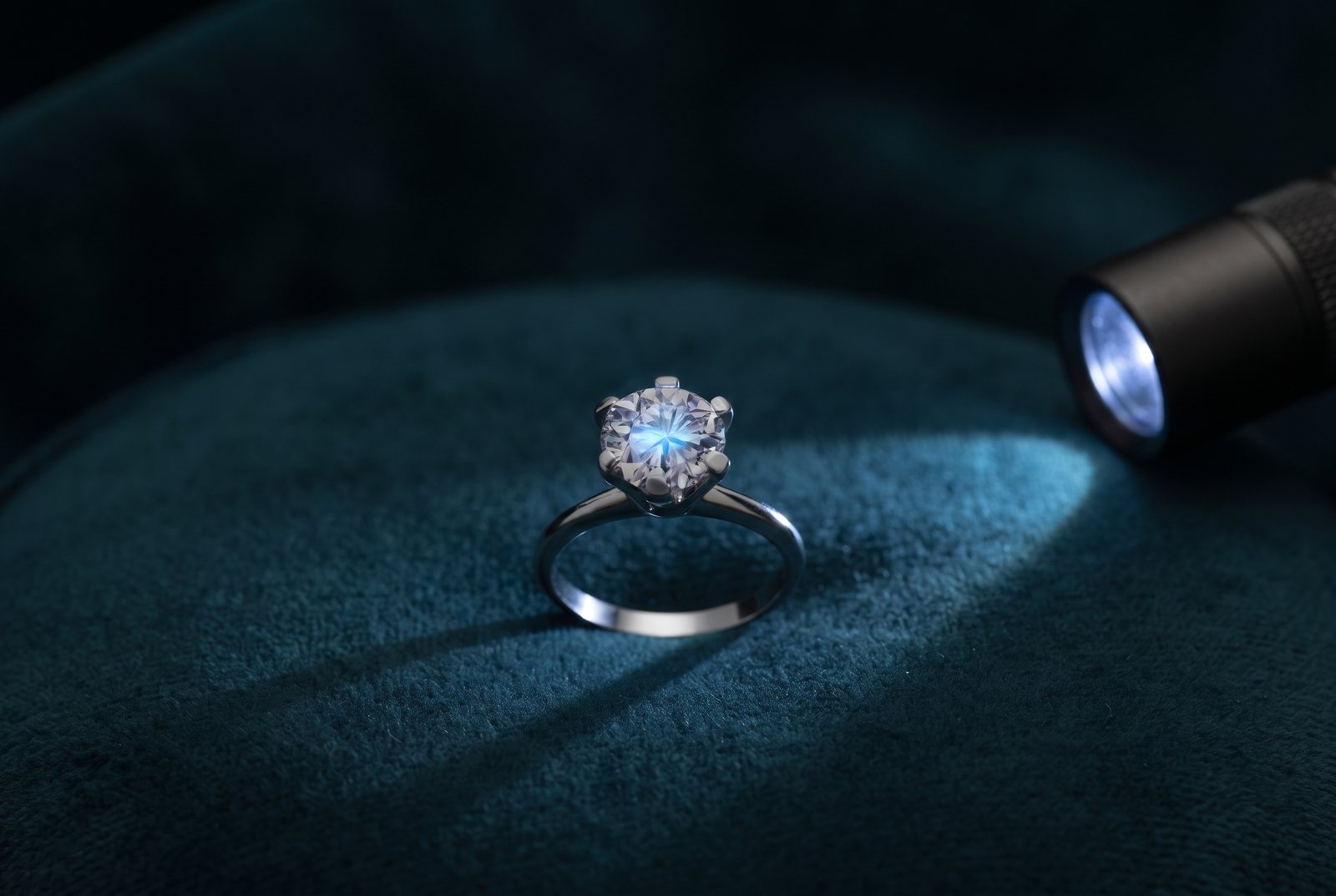
Short answer: Fluorescence is the faint glow, usually blue, that some diamonds give off under ultraviolet (UV) light. The report lists it as “None, Faint, Medium, Strong, Very Strong”. In daylight it does not affect how most stones look; in slightly yellowish stones, blue fluorescence can even make the stone look a little whiter. In very rare cases, very strong fluorescence can give a stone a slightly hazy look. Its effect on price is usually downwards.
What causes fluorescence?
Very small amounts of trace elements (such as nitrogen) and structural differences in a diamond’s crystal absorb ultraviolet light and give it back as visible light. So fluorescence is not a “flaw” but part of the stone’s identity. A large share of natural diamonds show fluorescence of varying strength; its most common colour is blue.
Fluorescence grades
| On the report | Meaning | Effect on appearance |
|---|---|---|
| None | No fluorescence | None |
| Faint | Very slight | Not noticeable |
| Medium | Moderate | Usually not noticeable in daylight |
| Strong | Strong | Not noticeable in most stones; rarely a slight haze |
| Very Strong | Very strong | Some stones may look slightly milky |
You notice fluorescence most in sunlight and especially where there are UV lamps (such as the lighting in some venues): the stone gives off a faint blue glow.
Is fluorescence good or bad?
Sometimes an advantage
In stones with a slight warm tone, such as I or J, blue fluorescence can balance the yellowish tint and make the stone look a little whiter in daylight. Because these stones have fluorescence, they can also be priced lower; so it is possible both to look whiter and to pay less.
Sometimes a reason for care
In colourless stones (D–F), strong fluorescence lowers the price, because the market does not want fluorescence in these stones. Very strong fluorescence giving a stone a slightly hazy or oily look is rare but possible, so stones with “Very Strong” fluorescence should be chosen carefully.
How does fluorescence affect the price?
Generally, the stronger the fluorescence, the lower the price; the effect is greatest at the top colour grades. In the middle and lower colour grades the difference is smaller. This is an opportunity for those who want to make the most of their budget: a stone with “Medium” or “Strong” fluorescence that does not look hazy can be good value. Ways to make the most of your budget.
Where to look on the report: fluorescence is written as a separate line next to colour and clarity. Read this line too when you read the stone’s 4Cs. How to read a certificate.
Fluorescence in lab-grown diamonds
Lab-grown diamonds usually have no fluorescence or only faint fluorescence; some stones may show weak fluorescence in colours different from natural diamonds (such as orangey or greenish). This difference is seen with laboratory instruments, not the eye, and it does not affect the stone’s look in daylight. Fluorescence is stated separately on the report for every stone. CVD and HPHT.
Frequently asked questions
No. Fluorescence does not affect how most stones look day to day; it can even make slightly yellowish stones look whiter. Only stones with very strong fluorescence need careful choosing. Usually not in normal light. In sunlight or under UV light, the stone may give off a faint blue glow. Usually yes, especially in colourless (D–F) stones. That can make stones with fluorescence but a clean look attractive for the budget. They can, but usually they have none or only faint fluorescence. Each stone’s fluorescence is written separately on its report.Is a diamond with fluorescence bad?
Can you see fluorescence with the eye?
Does fluorescence lower the price?
Do lab-grown diamonds have fluorescence?
Blog
Keep reading
Diamond Basics
What Do F, G and H Colour Diamonds Mean?
The diamond colour scale runs from D to Z. We explain the difference between E, F, G and H colour stones, whether you can…
3 min read
Diamond Basics
Diamond Sparkle: What Are Brilliance, Fire and Scintillation?
A diamond's sparkle comes from three separate light effects: brilliance, fire and scintillation. We explain what decides them and what people really mean by…
3 min read
Diamond Basics
Diamond Clarity Scale: From FL to I3
Clarity is how visible the tiny marks inside a diamond are. We explain the FL, IF, VVS, VS, SI and I grades with a…
3 min read
Diamond Basics
Cubic Zirconia vs Diamond: What Is the Difference?
Cubic zirconia looks like a diamond at first glance, but it is a very different stone. We explain the differences in hardness, light, weight…
3 min read