Diamond Basics
How to Tell If a Diamond Is Real
How reliable are home tests? We explain, step by step, the sound ways to find out whether a stone is a real diamond, and how to check its certificate and laser inscription.
4 min readUpdated: October 6, 2026
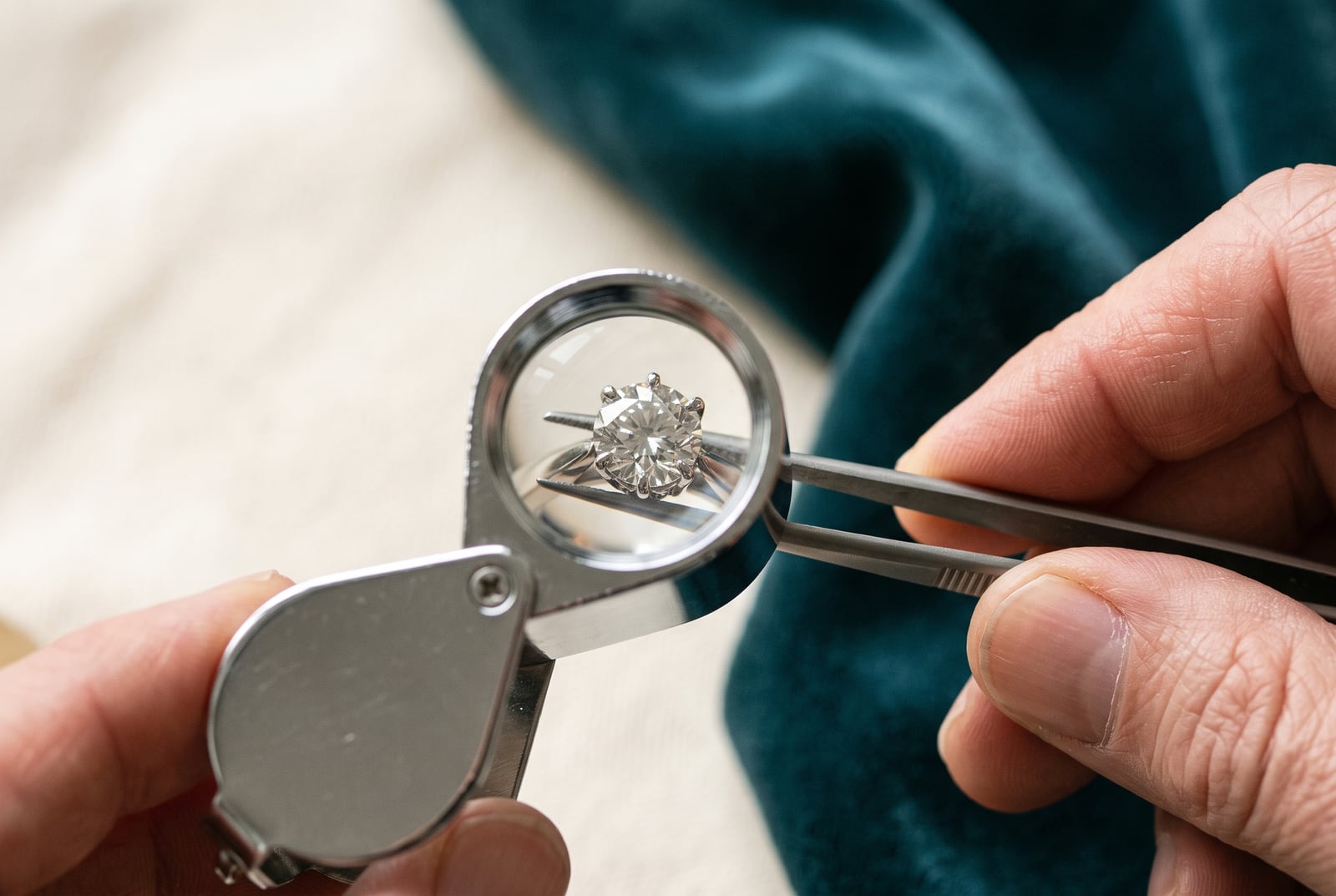
Short answer: You cannot tell for certain at home whether a stone is a real diamond. Home tests only give a hint and can mislead you. The reliable way has three steps: the stone’s certificate, checking the certificate number on the issuing laboratory’s website, and making sure the laser inscription on the stone matches that number.
How reliable are home tests?
There are a few tests that are often described online. None of them is proof on its own.
| Test | What you do | Why it misleads |
|---|---|---|
| Breath (fog) test | Breathe on the stone; on a diamond the fog clears at once. | Moissanite also conducts heat well and behaves the same way. |
| Read-through test | Place the stone on printed text; you cannot read the text through a diamond. | Only works on a loose stone, and the result changes with the cut. |
| Water test | Drop the stone in water; a diamond sinks. | Glass and many other stones sink too. |
| Scratch test | Scratch glass with the stone. | Moissanite and other hard stones scratch glass too. It can damage the stone and the setting; do not do it. |
These tests can help rule out glass or cubic zirconia, but they are not enough to separate moissanite, the stone that looks most like diamond. For details on moissanite: what is moissanite.
How does a jeweller tell?
- Diamond tester: Measures the stone’s thermal conductivity. It separates diamond from glass and cubic zirconia but may mistake moissanite for diamond.
- Moissanite tester: Also measures electrical conductivity and separates moissanite from diamond.
- Loupe: At ten times magnification the jeweller looks at the facet edges, the stone’s inner features and the laser inscription on its girdle.
- Weight and measurements: The stone’s weight and its millimetre size should match. A 1-carat round diamond, for example, is about 6.4 mm across.
The surest way: certificate and laser inscription
- Ask for the certificate. A report from an independent laboratory such as GIA, IGI or HRD documents that the stone is a diamond and records its characteristics.
- Check the number yourself. Enter the report number on the verification page of the laboratory’s own website. The details you see there should be the same as the report in your hand.
- Have the laser inscription checked. On most certified stones the report number is laser-inscribed on the girdle (the widest edge). It is invisible to the naked eye; a jeweller shows it under a loupe. This number must match the number on the report.
If all three steps check out, you can be sure the stone in your hand is the diamond described in that report. We explain what the report says in GIA and IGI certificates.
Does a lab-grown diamond test as real?
Yes. A lab-grown diamond is made of carbon and tests as diamond on diamond testers, because it really is a diamond.
The hard part is telling whether a diamond is natural or grown in a laboratory. The two cannot be told apart by eye, with a loupe or with standard jewellers’ testers; this takes special instruments in gemmological laboratories. That is why the origin is stated clearly on the report, and lab-grown stones usually carry a laser inscription on the girdle saying so.
Ask for three things when you buy: an independent laboratory report for the stone, the chance to check the report number yourself, and a sales document that states the stone’s characteristics (carat, colour, clarity, natural or lab-grown).
Frequently asked questions
You cannot be certain at home. Fog, read-through and water tests only give a hint; similar stones such as moissanite can pass them. A certain answer needs a certificate and a jeweller’s check. The paper can be copied. That is why you should check the report number on the laboratory’s own website and see that the laser inscription on the stone’s girdle carries the same number. It shows as diamond. A lab-grown diamond is chemically a diamond; testers cannot tell it apart from a natural diamond. Moissanite sparkles more colourfully and shows doubling when viewed through a loupe. A certain answer needs a tester that measures electrical conductivity, or a certificate.How can you tell at home if a diamond is real?
Can a diamond certificate be fake?
What does a lab-grown diamond show on a diamond tester?
How do you tell moissanite from diamond?
Blog
Keep reading
Diamond Basics
Diamond Clarity Scale: From FL to I3
Clarity is how visible the tiny marks inside a diamond are. We explain the FL, IF, VVS, VS, SI and I grades with a…
3 min read
Diamond Basics
Cubic Zirconia vs Diamond: What Is the Difference?
Cubic zirconia looks like a diamond at first glance, but it is a very different stone. We explain the differences in hardness, light, weight…
3 min read
Diamond Basics
Diamond Sparkle: What Are Brilliance, Fire and Scintillation?
A diamond's sparkle comes from three separate light effects: brilliance, fire and scintillation. We explain what decides them and what people really mean by…
3 min read
Diamond Basics
What Is Diamond Fluorescence? Good or Bad?
Fluorescence is the blue glow some diamonds give off under ultraviolet light. We explain how it appears on the report, whether it affects how…
3 min read