Diamond Basics
What Is Moissanite? How It Differs from a Diamond
Moissanite looks very much like a diamond, but it is not a diamond. We explain what it is made of, how to tell it apart from a diamond and why it should not be confused with a lab-grown diamond.
4 min readUpdated: October 6, 2026
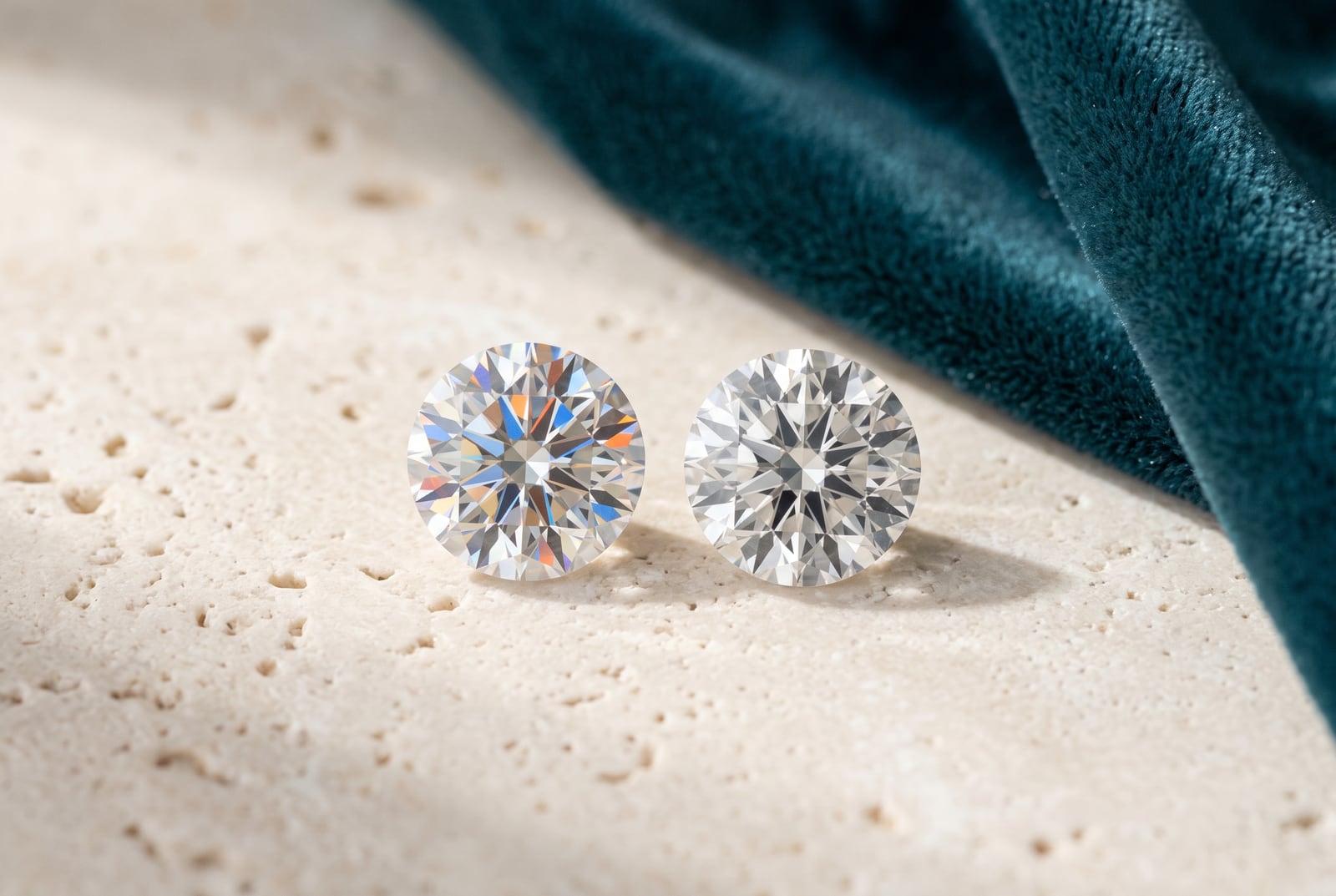
Short answer: Moissanite is a stone made of silicon carbide that looks very much like a diamond but is not a diamond. Almost all moissanite used in jewellery is made in a laboratory. A lab-grown diamond, on the other hand, is made of carbon and is a real diamond; the two are not the same thing.
What is moissanite and where does it come from?
Moissanite is named after the French chemist Henri Moissan, who found it in 1893 in a meteorite crater in Arizona. It is so rare in nature that natural moissanite large enough for jewellery practically does not exist. The moissanite you see in jewellery shops today is silicon carbide crystal grown in a laboratory.
Moissanite is not cheap glass or cubic zirconia designed to imitate a diamond; it is a hard, brilliant stone in its own right. But its chemistry is different from diamond, so it cannot be called a diamond.
The differences between moissanite and diamond
| Property | Moissanite | Diamond (natural or lab-grown) |
|---|---|---|
| Material | Silicon carbide (SiC) | Pure carbon (C) |
| Hardness (Mohs) | 9.25 | 10 |
| Refractive index | 2.65 – 2.69 | 2.42 |
| Coloured sparkle (dispersion) | 0.104 | 0.044 |
| Double refraction | Yes | No |
| Diamond report (GIA, IGI) | Not possible | Yes |
The most visible difference in the table is the coloured sparkle. Moissanite splits light into colours more than twice as strongly as diamond, so it throws rainbow-like flashes, especially in sunlight and in larger stones. A diamond’s sparkle is whiter and crisper.
Can you tell moissanite from diamond by eye?
In small stones most people cannot see the difference. It becomes clearer as the stone gets bigger:
- Coloured flashes: Under light, moissanite flashes more colourfully, like a disco ball. In a diamond, white light dominates.
- Doubling: Moissanite is doubly refractive. Seen through a loupe from certain angles, the edges of the back facets appear doubled. This does not happen in a diamond.
- Body tone: Some moissanite, especially older production, can show a faint yellowish or greenish undertone.
Does a diamond tester detect moissanite?
Not every tester does. The simple diamond tester pens common in jewellery shops measure thermal conductivity. Because moissanite conducts heat very well, just like diamond, these testers can show it as “diamond”. For a reliable result, testers that also measure electrical conductivity and can separate moissanite are used.
That is why the surest way to know what a stone is, is a document rather than a device. We explain it in detail in how to tell if a diamond is real.
Are moissanite and lab-grown diamond the same thing?
No, and this is the most common confusion. Both are made in a laboratory, but one is a diamond and the other is not.
- A lab-grown diamond is pure carbon. Its chemistry, hardness and light are the same as a natural diamond. It tests as diamond on diamond testers and receives a diamond report from organisations such as GIA and IGI.
- Moissanite is silicon carbide. It resembles diamond but is a different stone and cannot receive a diamond report.
You can read how lab-grown diamonds are grown on our what is a lab-grown diamond page.
When buying: always ask what a stone is when it is sold with vague words such as “lab stone”, “synthetic stone” or “diamond look”. If the stone is a diamond, there is a report that shows it. If there is no report and the stone is moissanite, you should be told so clearly.
Frequently asked questions
No. Moissanite is a separate stone made of silicon carbide, while diamond is made of carbon. Moissanite resembles diamond but is not a diamond. Moissanite is a hard stone (Mohs 9.25) and does not scratch easily in daily wear. Like any stone it can look dull when coated with oil and dirt; once cleaned, it shines as before. A lab-grown diamond is a real diamond: it is made of carbon and receives a diamond report. Moissanite is a different stone that looks like diamond. Because both are made in a laboratory, they are often confused. Simple testers that only measure thermal conductivity may mistake moissanite for diamond. Testers that also measure electrical conductivity tell them apart.Is moissanite a diamond?
Does moissanite go cloudy or dark over time?
What is the difference between moissanite and a lab-grown diamond?
Does moissanite pass a diamond test?
Blog
Keep reading
Diamond Basics
Diamond Clarity Scale: From FL to I3
Clarity is how visible the tiny marks inside a diamond are. We explain the FL, IF, VVS, VS, SI and I grades with a…
3 min read
Diamond Basics
Cubic Zirconia vs Diamond: What Is the Difference?
Cubic zirconia looks like a diamond at first glance, but it is a very different stone. We explain the differences in hardness, light, weight…
3 min read
Diamond Basics
Diamond Sparkle: What Are Brilliance, Fire and Scintillation?
A diamond's sparkle comes from three separate light effects: brilliance, fire and scintillation. We explain what decides them and what people really mean by…
3 min read
Diamond Basics
What Is Diamond Fluorescence? Good or Bad?
Fluorescence is the blue glow some diamonds give off under ultraviolet light. We explain how it appears on the report, whether it affects how…
3 min read