Diamond Basics
Can a Diamond Tester Detect a Lab-Grown Diamond?
The testers jewellers use can tell whether a stone is a diamond, but most cannot tell whether it is natural or lab-grown. We explain why, and what can tell them apart.
3 min readUpdated: October 7, 2026
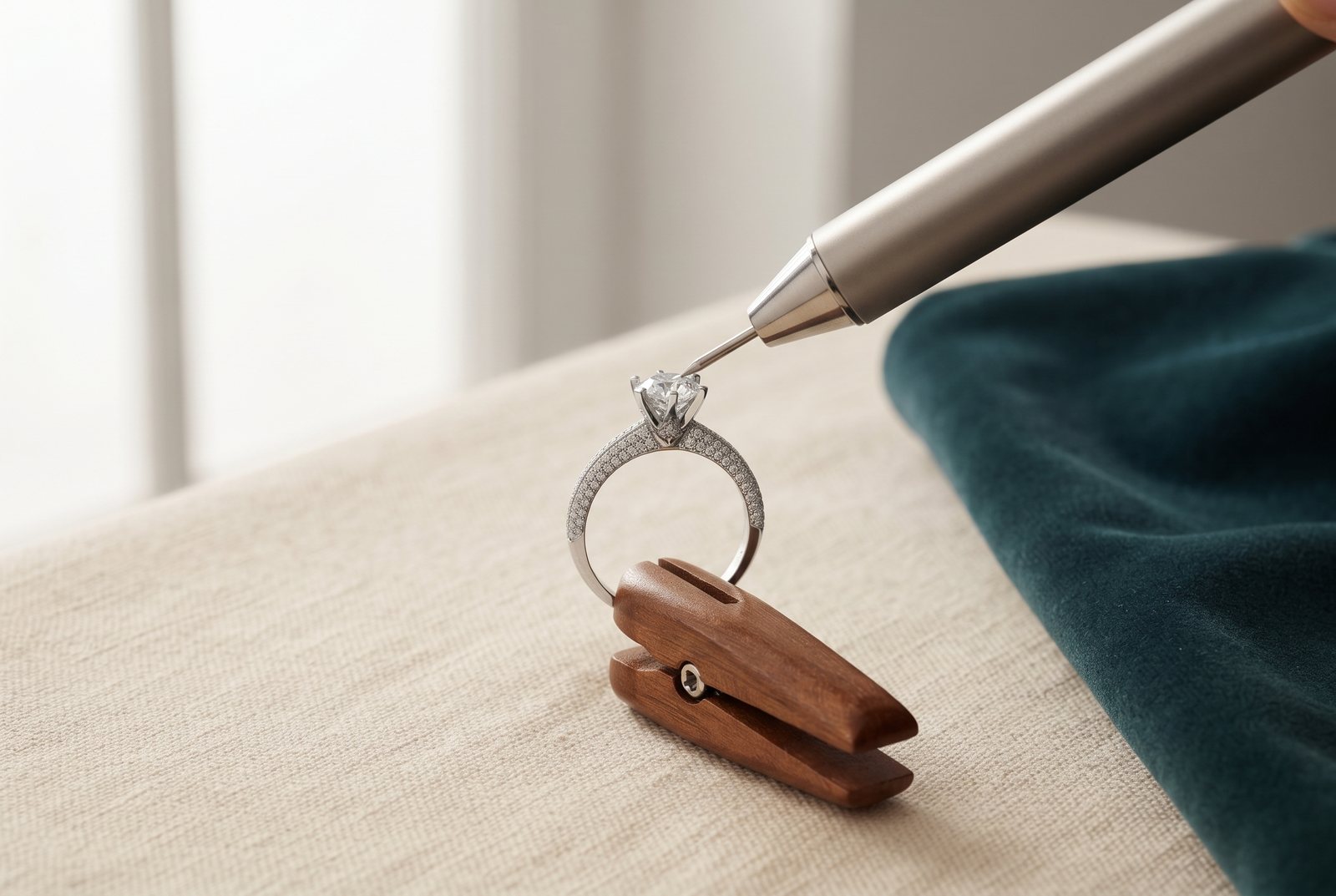
Short answer: The diamond testers jewellers use can tell whether a stone is a diamond, but not whether it is natural or grown in a laboratory. A lab-grown diamond is a real diamond and conducts heat the same way, so the tester shows it as “diamond” too. Telling natural from lab-grown diamond takes advanced instruments in gemmological laboratories, which is why the stone’s report is decisive.
How does a diamond tester work?
Thermal conductivity
Diamond conducts heat extremely well. A heat-measuring tester (thermal tester) measures how fast heat spreads when its tip touches the stone. Cubic zirconia, glass and most imitation stones do not conduct heat well, so the tester picks them out at once. Cubic zirconia versus diamond.
The moissanite problem and electrical conductivity
Moissanite also conducts heat well, so a tester that only measures heat may mistake it for diamond. That is why “multi-testers” also measure electrical conductivity: moissanite conducts electricity, while most diamonds do not. What is moissanite?
What does a lab-grown diamond show on a tester?
A lab-grown diamond shows as diamond on heat testers, because it is a real diamond. On multi-testers it usually shows as diamond too. There is a rare exception: some diamonds with trace amounts of boron in their crystal (some natural blue diamonds and some lab-grown diamonds) can conduct electricity slightly, and simple testers may wrongly show them as moissanite. This does not mean the stone is not a diamond; it is a limit of the tester.
How do you tell natural from lab-grown diamond?
This distinction is made by looking at very fine differences in the stone’s crystal: growth patterns, trace elements and patterns under ultraviolet light. The tools used for this are:
- Spectroscopy: Measures how the stone absorbs light and determines the diamond’s “type”.
- Ultraviolet imaging: Shows growth patterns under short-wave UV light; natural and lab-grown stones have different patterns.
- Screening devices: Quickly scan large numbers of small stones and set aside those that need further examination.
These instruments are found mostly in gemmological laboratories. The result is written on the stone’s report as “laboratory-grown” or “natural”. How to read a certificate.
Why does this matter so much? Because lab-grown and natural diamonds look the same but are priced differently. That is why a lab-grown diamond should always be sold with its origin stated clearly and with its report. We, too, state clearly that every stone we offer was grown in a laboratory.
Can you test at home?
Home tests such as fog, water and read-through tests are not conclusive, and telling a lab-grown diamond from a natural one at home is impossible. The surest way to know a stone is real is its report, and the report number matching the laser inscription on the stone’s girdle. How to tell if a diamond is real.
When having a stone tested at a jeweller
- Ask which tester is used: heat only, or heat and electricity?
- Remember that the tester saying “diamond” does not mean the stone is natural.
- If you want to know the origin, have the stone examined by an independent gemmological laboratory.
Frequently asked questions
Yes. Because a lab-grown diamond is a real diamond, it shows as diamond on heat-measuring testers. Jewellers’ standard testers cannot. This distinction is made with gemmological laboratory instruments such as spectroscopy and ultraviolet imaging. It can on testers that only measure heat. Multi-testers that also measure electrical conductivity tell moissanite apart. First they look through a loupe, then they test with instruments that measure heat and electrical conductivity. When they need to be sure of the origin, they send the stone to an independent laboratory.Does a lab-grown diamond test as diamond?
Can a tester tell natural from lab-grown diamonds?
Does moissanite test as diamond?
How do jewellers test a diamond?
Blog
Keep reading
Diamond Basics
What Do F, G and H Colour Diamonds Mean?
The diamond colour scale runs from D to Z. We explain the difference between E, F, G and H colour stones, whether you can…
3 min read
Diamond Basics
Diamond Sparkle: What Are Brilliance, Fire and Scintillation?
A diamond's sparkle comes from three separate light effects: brilliance, fire and scintillation. We explain what decides them and what people really mean by…
3 min read
Diamond Basics
Diamond Clarity Scale: From FL to I3
Clarity is how visible the tiny marks inside a diamond are. We explain the FL, IF, VVS, VS, SI and I grades with a…
3 min read
Diamond Basics
Cubic Zirconia vs Diamond: What Is the Difference?
Cubic zirconia looks like a diamond at first glance, but it is a very different stone. We explain the differences in hardness, light, weight…
3 min read