Diamond Basics
The 4Cs of Diamonds: Carat, Cut, Colour and Clarity
The 4Cs are the four criteria that determine a diamond's value. We explain what each one means, which one the eye notices most and how to divide your budget.
3 min readUpdated: October 7, 2026
Short answer: The 4Cs are the four criteria that set a diamond’s value: Carat, Cut, Colour and Clarity. Carat describes the stone’s weight, cut its light, colour its whiteness and clarity how visible the marks inside it are. The cut is what the eye notices most; the secret of spending a budget well is to keep colour and clarity at “eye clean” without compromising on cut.
1. Carat: weight
Carat is the stone’s weight: 1 carat is 0.2 grams. As carat rises the stone gets bigger, but how big it looks also depends on the shape and cut proportions. Price does not rise in a straight line with carat; it jumps at thresholds such as 0.50, 1 and 2 carats. What is a carat? · How many carats should a solitaire be?
2. Cut: light
Cut means the stone’s proportions, symmetry and polish. It is what makes light enter the stone and come back out through the top. A well-cut stone sparkles brightly even if it is small; a badly cut stone looks dull even if it is large. Reports give round stones a grade from Excellent to Poor. Cut quality.
3. Colour: whiteness
The colour scale starts at D (completely colourless) and moves towards a light yellow at Z. D–F count as colourless and G–J as near colourless. G and H colour stones look white when worn; the difference between D and G is usually seen only side by side and in special light. What do F, G and H colour mean?
4. Clarity: inner marks
Most diamonds have tiny marks left inside them as they formed. Clarity is graded by how visible these marks are under 10x magnification: FL (flawless) at the top and I3 at the bottom. A VS stone looks eye clean. The clarity scale.
Which one matters most?
| Criterion | Can the eye see it? | Our suggestion |
|---|---|---|
| Cut | Yes, it is noticed most | Do not compromise: Excellent or Very Good |
| Carat | Yes, as size | Consider just below a threshold |
| Colour | A little, side by side | In white gold, G–H is enough |
| Clarity | Usually not | VS2–SI1 is enough if eye clean |
The fifth C: certificate
There is a common saying among jewellers: the fifth C is the “certificate”. Each of the four Cs is established by an independent laboratory’s report, not by the seller’s word. The report number can be checked and matched with the laser inscription on the stone’s girdle. How to read a certificate.
An example of splitting the budget: with the same budget, choosing “0.90 carat, G colour, VS2, Excellent cut” instead of “1 carat, D colour, VVS1, Good cut” usually gives a more beautiful, brighter stone on the finger. What the eye notices is the sparkle.
The 4Cs in lab-grown diamonds
Lab-grown diamonds are graded on the same four criteria; their report also states that they were grown in a laboratory. Because they are more affordable at the same 4Cs, you can go up one or two criteria while keeping the same budget. What is a lab-grown diamond?
Frequently asked questions
Carat, Cut, Colour and Clarity. These four criteria together decide a diamond’s value and appearance. The cut is what the eye notices most, because it decides the sparkle. Colour and clarity can be one grade more flexible as long as the stone looks eye clean. It is certainly the top quality, but the difference usually cannot be seen. Choosing a bigger or better-cut stone with the same budget usually gives a more beautiful result. Yes. Lab-grown diamonds are also graded and reported on carat, cut, colour and clarity.What are the 4Cs of a diamond?
Which of the 4Cs matters most?
Is a D colour, VVS diamond worth it?
Do the 4Cs apply to lab-grown diamonds?
Blog
Keep reading
Diamond Basics
Diamond Clarity Scale: From FL to I3
Clarity is how visible the tiny marks inside a diamond are. We explain the FL, IF, VVS, VS, SI and I grades with a…
3 min read
Diamond Basics
Cubic Zirconia vs Diamond: What Is the Difference?
Cubic zirconia looks like a diamond at first glance, but it is a very different stone. We explain the differences in hardness, light, weight…
3 min read
Diamond Basics
Diamond Sparkle: What Are Brilliance, Fire and Scintillation?
A diamond's sparkle comes from three separate light effects: brilliance, fire and scintillation. We explain what decides them and what people really mean by…
3 min read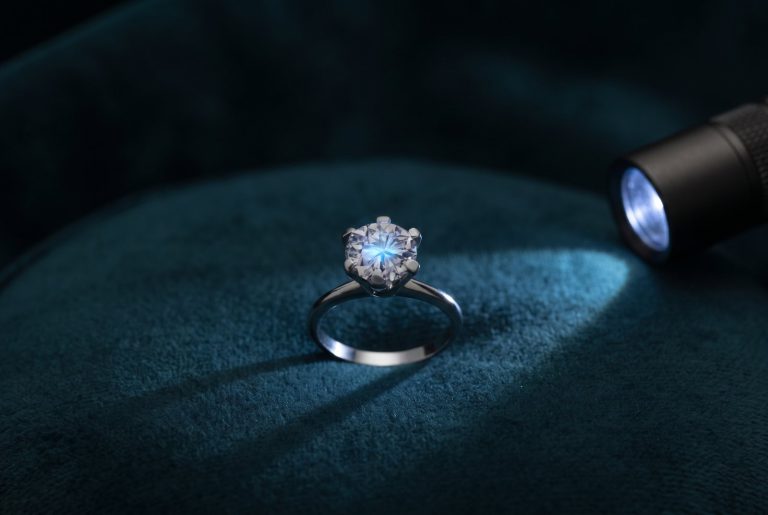
Diamond Basics
What Is Diamond Fluorescence? Good or Bad?
Fluorescence is the blue glow some diamonds give off under ultraviolet light. We explain how it appears on the report, whether it affects how…
3 min read