Diamond Basics
What Is Diamond Cut Quality? Excellent, Very Good, Good
Cut quality decides how much a diamond sparkles. We explain the difference between Excellent and Good, proportions, symmetry and polish, and where to look on the report.
4 min readUpdated: October 7, 2026
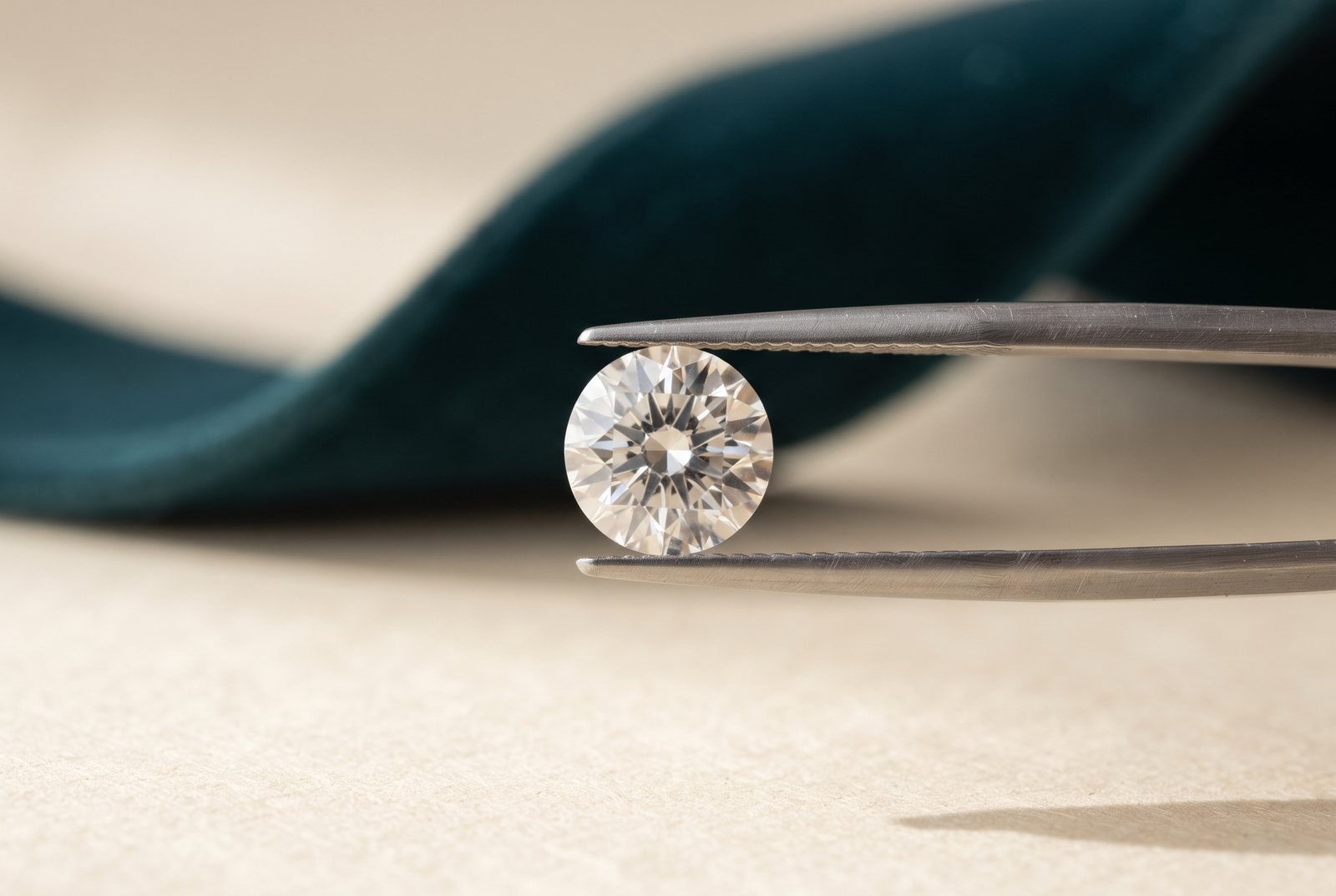
Short answer: Cut quality describes how good a diamond’s proportions, symmetry and polish are; it is the most important criterion for how much the stone sparkles. For round stones, reports give the grades Excellent, Very Good, Good, Fair and Poor. Because this grade makes the biggest visible difference in everyday wear, cut is the first characteristic not to compromise on when choosing a diamond.
What does cut quality measure?
Here “cut” does not mean the stone’s shape (round, oval…) but how well that shape has been made. It has three parts:
- Proportions: The width of the table (the large flat surface on top), the depth of the stone, and the crown and pavilion angles. These decide how light travels inside the stone.
- Symmetry: How the facets line up with each other and how they are shaped.
- Polish: How smooth the surfaces are.
Why do proportions matter so much?
In a well-proportioned stone, light enters from the top, reflects off the lower facets and returns to the eye through the top. If the stone is cut too shallow, light escapes from the bottom and the centre looks glassy, like a “window”. If it is cut too deep, light escapes from the sides and the centre goes dark. Either way the stone looks duller, even at the same carat. We explain the three effects light creates in a stone (brilliance, fire and sparkle) in diamond brilliance.
For a round brilliant, proportions that work well are roughly: a table of 53–58% and a total depth of 59–62.5%. These ranges are not enough on their own; the harmony of the angles matters too. That is why the overall cut grade on the report is the most practical measure.
Cut grades: Excellent to Poor
| Grade | Meaning |
|---|---|
| Excellent (Ideal on some reports) | Proportions that return the most light; the liveliest sparkle |
| Very Good | Very close to Excellent; most people cannot see the difference |
| Good | Good, but noticeably less brilliant |
| Fair / Poor | Much light is lost; not recommended for jewellery |
The report also gives separate grades for Polish and Symmetry. Stones graded Excellent on all three are called “3EX” in the trade.
Cut in shapes other than round
For shapes such as oval, pear, marquise, princess and emerald, many reports do not give an overall cut grade, only polish and symmetry grades. With these stones you judge cut quality by looking at:
- Length-to-width ratio: It keeps the shape graceful. Oval proportions.
- The bow-tie effect: The dark shadow across the centre of elongated shapes; it should be faint.
- Depth and table: Very deep or very shallow stones are the extremes to avoid.
- Polish and symmetry grades: Both being Excellent or Very Good on the report is a good sign.
First in the budget: do not cut back on cut to gain carats. A 0.90-carat stone with an Excellent or Very Good cut usually looks bigger and brighter than a 1-carat stone with a Good cut, because it uses light better. What sets solitaire prices?
Cut in lab-grown diamonds
Lab-grown diamonds are cut with the same skill and receive the same cut grades. With a natural stone, the cutter sometimes compromises on proportions to save weight; with a lab-grown diamond the shape of the rough is more controlled, so a well-proportioned stone is often easier to find. Still, each stone’s report should be checked on its own. What are the 4Cs?
Frequently asked questions
It is usually very small and not noticeable unless you look side by side. Both give strong sparkle; at Good and below, the loss of light becomes noticeable. It is a trade term for stones graded Excellent for all three: cut, polish and symmetry. Many laboratories do not give an overall cut grade to shapes other than round, only polish and symmetry grades. For these stones, look at the length-to-width ratio, the depth and table percentages, and the polish and symmetry grades. In terms of the effect the eye can see, cut matters more. Colour can be relaxed down to the level that cannot be noticed when worn.Can you see the difference between Excellent and Very Good cut?
What does a 3EX diamond mean?
Why does my oval stone have no cut grade?
Which matters more, cut or colour?
Blog
Keep reading
Diamond Basics
Diamond Clarity Scale: From FL to I3
Clarity is how visible the tiny marks inside a diamond are. We explain the FL, IF, VVS, VS, SI and I grades with a…
3 min read
Diamond Basics
Cubic Zirconia vs Diamond: What Is the Difference?
Cubic zirconia looks like a diamond at first glance, but it is a very different stone. We explain the differences in hardness, light, weight…
3 min read
Diamond Basics
Diamond Sparkle: What Are Brilliance, Fire and Scintillation?
A diamond's sparkle comes from three separate light effects: brilliance, fire and scintillation. We explain what decides them and what people really mean by…
3 min read
Diamond Basics
What Is Diamond Fluorescence? Good or Bad?
Fluorescence is the blue glow some diamonds give off under ultraviolet light. We explain how it appears on the report, whether it affects how…
3 min read