Ring Guide
Oval Solitaire Ring: Why Is It the Most Popular Cut?
An oval solitaire looks larger at the same carat, lengthens the finger and is often more affordable. An oval stone guide covering the length-to-width ratio, the bow-tie effect and setting options.
5 min readUpdated: October 7, 2026
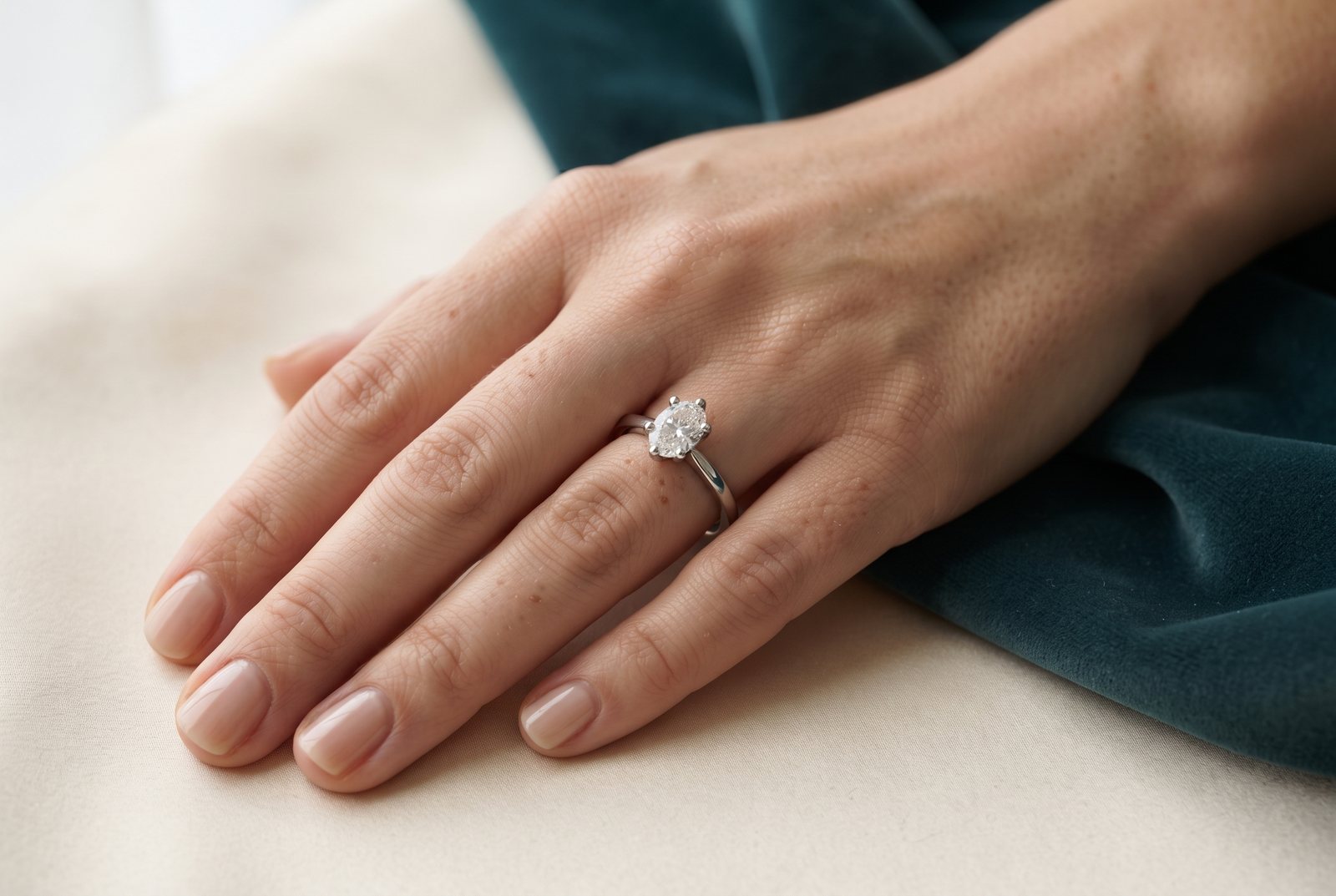
Short answer: An oval solitaire looks bigger than a round stone of the same carat, makes the finger look longer and slimmer, keeps most of the round cut’s sparkle and is often more affordable. These four advantages are why it has become the most popular cut for engagement rings in recent years.
What is the oval cut?
The oval cut is an elongated version of the round brilliant: it uses the same facet pattern, so it breaks up light much like a round stone. Because it has no corners, it is less likely to catch or chip than angular cuts. An “oval diamond ring” usually means a solitaire with this cut, and the oval stone is also used in halo and side-stone designs. It is a relatively young cut, developed in the late 1950s; today it is the most sought-after shape for solitaire rings after the round.
Why oval? Four advantages
1. It looks bigger at the same carat
An oval has a larger face than a round stone of the same weight, because its weight is spread along its length instead of its depth. On the finger it gives the impression of a “bigger stone”. It is one of the choices that makes the most of a budget.
2. It makes the finger look longer
Worn with its long axis along the finger, it slims and lengthens the finger. The effect is especially noticeable on short or wide fingers.
3. It keeps the sparkle
Compared with the calm light of step cuts such as the emerald cut, the oval gives a sparkle close to a round stone. It is the choice for those who want something “different but brilliant”.
4. It is often more affordable
The round cut loses the most rough diamond in cutting; the oval loses less. So an oval stone with the same characteristics is often priced lower than a round one.
What to check when choosing an oval stone
Length-to-width ratio
The ratio of the stone’s length to its width decides its look. Between 1.30 and 1.50 is a classic oval; closer to 1.30 it looks rounder, and above 1.50 it becomes longer and slimmer. You can see which suits you on a hand at true scale in our ring designer.
The bow-tie effect
Every oval stone has a dark, bow-tie-shaped shadow across the middle where light does not return. In a well-cut stone this shadow is faint and pleasant; in a poor cut it is strong and dark. The bow-tie is not written on the certificate; you see it by looking at the stone. In well-cut stones with balanced proportions, the bow-tie stays faint.
Symmetry
The two ends and the two sides of the oval should match; even a slight lopsidedness shows at once in a ring. The symmetry grade on the certificate should be “very good” or “excellent”.
Colour and clarity
Because the oval spreads light almost as well as a round stone, it hides small marks; at VS clarity it looks eye clean. For colour, elongated shapes show a little more tint at their ends; in a white gold setting, G–H colour offers a safe balance. For the grades: colour and clarity.
Setting options for an oval solitaire
- Classic four-prong: Shows the stone in the simplest way and lets in the most light. The basic form of our oval solitaire.
- Halo: A ring of tiny diamonds around the stone; it makes the stone look bigger and more brilliant. Halo solitaire.
- Pavé band: Tiny stones set along the band carry the light along the finger. Pavé solitaire.
- East-west oval: The stone’s long axis sits across the finger; different and modern.
How the same carat looks: A well-cut 1-carat round stone is about 6.4–6.5 mm across, while a 1-carat oval with classic proportions measures about 7.7×5.7 mm. Its long axis is more than 1 mm longer than the round stone. More: what is a carat.
What sets the price of an oval solitaire?
Carat, cut quality (especially symmetry and the bow-tie), colour and clarity, and the setting. An oval stone is often more affordable than a round stone of the same carat. With lab-grown diamonds the advantage grows: the same budget buys a stone that both looks bigger and is cleaner. We explain what sets the price; we give the current price for your stone choice on WhatsApp.
Frequently asked questions
Round is the classic and most brilliant choice; oval looks bigger, lengthens the finger and is often more affordable. Use the ring designer to see the stone on a hand: design your ring. Every oval has some; it is not a problem. A strong, dark bow-tie, however, shows poor cut quality. Choosing a well-cut stone with balanced proportions keeps the bow-tie to a minimum. About 7.7×5.7 mm in an oval with classic proportions. In longer ovals (ratio 1.50 and above), the length increases and the width decreases. As an engagement ring, on the ring finger with its long axis along the finger. In Turkey, some wear it on the right hand during the engagement and move it to the left at the wedding, while many wear it on the left from the proposal. More: which finger does a ring go on.Oval or round solitaire?
Is the bow-tie effect in an oval stone a flaw?
How many mm is a 1-carat oval?
Which finger does an oval solitaire go on?
Blog
Keep reading
Ring Guide
Can a Ring Be Resized Up or Down?
A ring's size can usually be changed by one or two sizes, but not on every style. We explain which rings can be adjusted…
4 min read
Ring Guide
Ring Design: Design Your Own Solitaire in 4 Steps
Designing your own ring is easier than you think: shape, carat, gold colour and quality. We explain how to design your solitaire in four…
4 min read
Ring Guide
Emerald Cut Solitaire: The Elegance of a Step Cut
The emerald cut is a step cut that shows off clarity and depth more than sparkle. We explain why clarity matters so much and…
3 min read
Ring Guide
How to Wear a Solitaire and a Wedding Band Together
How to wear a solitaire and a wedding band on the same finger in harmony: order, width, height and colour. We explain how to…
4 min read