Diamond Basics
What Do Artificial and Synthetic Diamond Mean?
The words 'artificial' and 'synthetic' are used both for real lab-grown diamonds and for imitation stones. We explain which is which and how to avoid the confusion.
3 min readUpdated: October 7, 2026
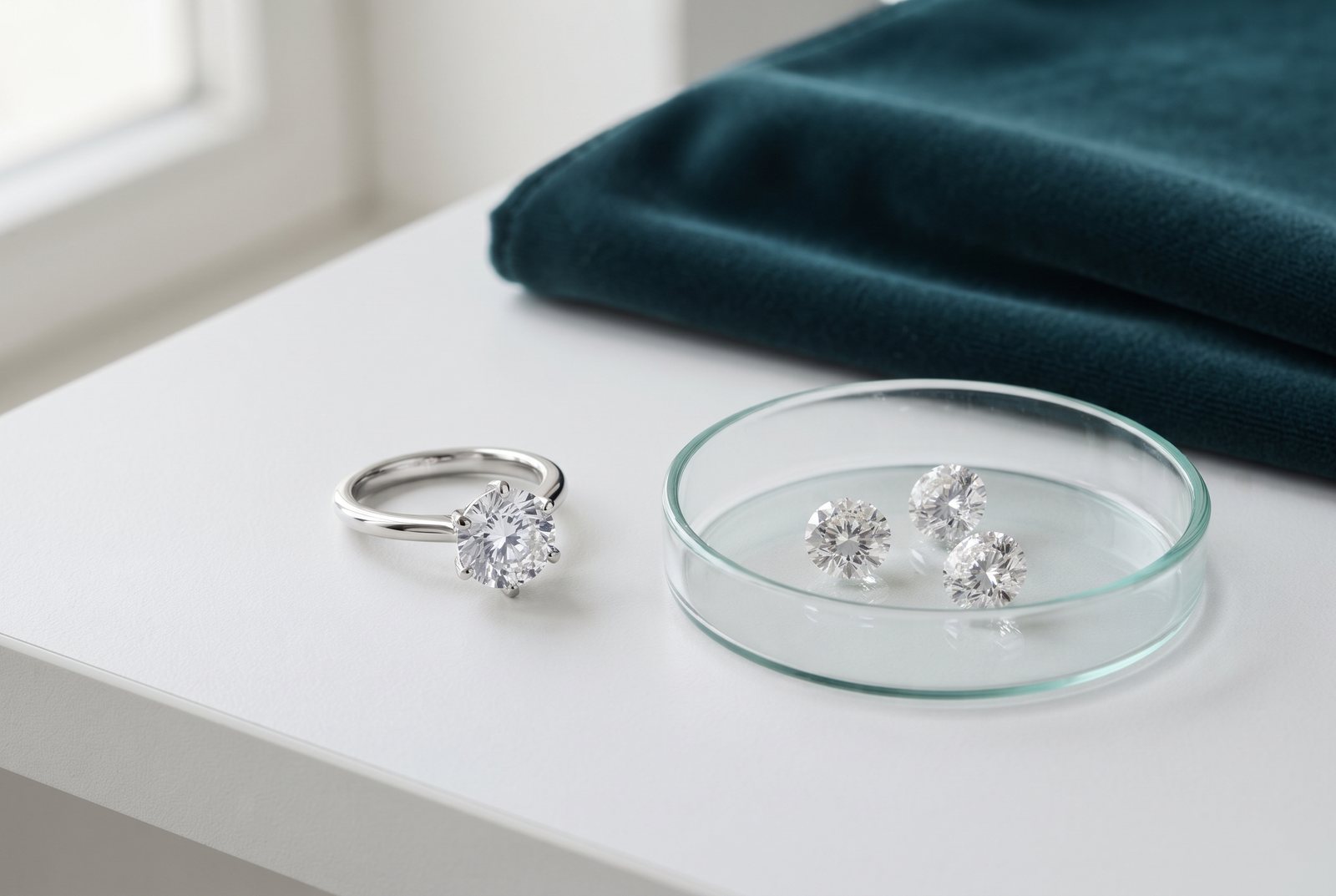
Short answer: In everyday speech, “artificial diamond” and “synthetic diamond” are used for two different things: sometimes a real diamond grown in a laboratory, and sometimes imitation stones that look like diamond. In gemmological language, “synthetic diamond” means the same as lab-grown diamond and is a real diamond. Stones such as cubic zirconia and moissanite are not diamonds. The way to avoid confusion is plain language that asks clearly what the stone is, and an independent report.
Three terms, three different things
| Term | What is it? | Is it a diamond? |
|---|---|---|
| Lab-grown diamond | A diamond grown in a laboratory | Yes |
| Synthetic diamond (in gemmology) | The technical name for a lab-grown diamond | Yes |
| Imitation (simulant) stone | A different material that looks like diamond | No |
Does “synthetic” mean fake?
No. In gemmology, “synthetic” means a stone has the same chemistry and crystal structure as the natural one but was made by people. A synthetic diamond is pure carbon, has a hardness of 10 and bends light like a diamond. Today the terms “lab-grown diamond” or “laboratory-grown diamond” are preferred for these stones because they are clearer, and international rules require them to be sold with their origin stated clearly. What is a lab-grown diamond?
Imitation stones: the look-alikes
- Cubic zirconia: The most common imitation. It is softer than diamond, scratches and goes cloudy over time, and is heavier. Cubic zirconia versus diamond.
- Moissanite: One of the stones that looks most like diamond, but it is silicon carbide; it shows more coloured fire and double refraction. What is moissanite?
- Glass and other stones: Much lower hardness and light; noticed quickly.
How to avoid confusion
- Ask a clear question: “Is this stone a diamond? Is it natural or grown in a laboratory?”
- Ask for a report: A report from an independent laboratory states what the stone is and its origin. How to read a certificate.
- Have it written on the invoice: The stone’s type and origin should appear clearly on the invoice or an attachment.
- Do not trust home tests: Water, fog and read-through tests are not conclusive. How to tell if a diamond is real.
Our language: we do not use the word “artificial” to describe our stones, because it suggests imitation stones. The stones we offer are real diamonds grown in a laboratory, and the origin of every stone is stated clearly.
Which should you choose?
If you want a real diamond but find the price of a natural diamond too much for your budget, a lab-grown diamond is the right choice: the same stone, the same light, a more affordable price. An imitation stone is a different material; even if it costs less, it does not give the hardness, light and durability of a diamond. The pros and cons: should you buy a lab-grown diamond?
Frequently asked questions
It depends. A diamond grown in a laboratory is a real diamond; but some sellers also offer imitation stones such as cubic zirconia as “artificial diamonds”. The report shows what the stone is. In gemmological language it is the technical name for a diamond grown in a laboratory. It has the same chemistry and properties as a natural diamond. Not with the naked eye. Its origin is determined with special instruments in gemmological laboratories and written on the report. No. A lab-grown diamond is a real diamond; cubic zirconia is a softer, different material that looks like diamond.Is an artificial diamond a real diamond?
What does synthetic diamond mean?
How can you tell a synthetic diamond?
Are a lab-grown diamond and cubic zirconia the same thing?
Blog
Keep reading
Diamond Basics
Diamond Clarity Scale: From FL to I3
Clarity is how visible the tiny marks inside a diamond are. We explain the FL, IF, VVS, VS, SI and I grades with a…
3 min read
Diamond Basics
Cubic Zirconia vs Diamond: What Is the Difference?
Cubic zirconia looks like a diamond at first glance, but it is a very different stone. We explain the differences in hardness, light, weight…
3 min read
Diamond Basics
Diamond Sparkle: What Are Brilliance, Fire and Scintillation?
A diamond's sparkle comes from three separate light effects: brilliance, fire and scintillation. We explain what decides them and what people really mean by…
3 min read
Diamond Basics
What Is Diamond Fluorescence? Good or Bad?
Fluorescence is the blue glow some diamonds give off under ultraviolet light. We explain how it appears on the report, whether it affects how…
3 min read