Ring Guide
Marquise Cut Ring: Features and Buying Guide
The marquise is a long shape with two pointed ends and one of the cuts that looks largest for its carat. We explain its proportions, the bow-tie effect and how its tips are protected.
3 min readUpdated: October 7, 2026
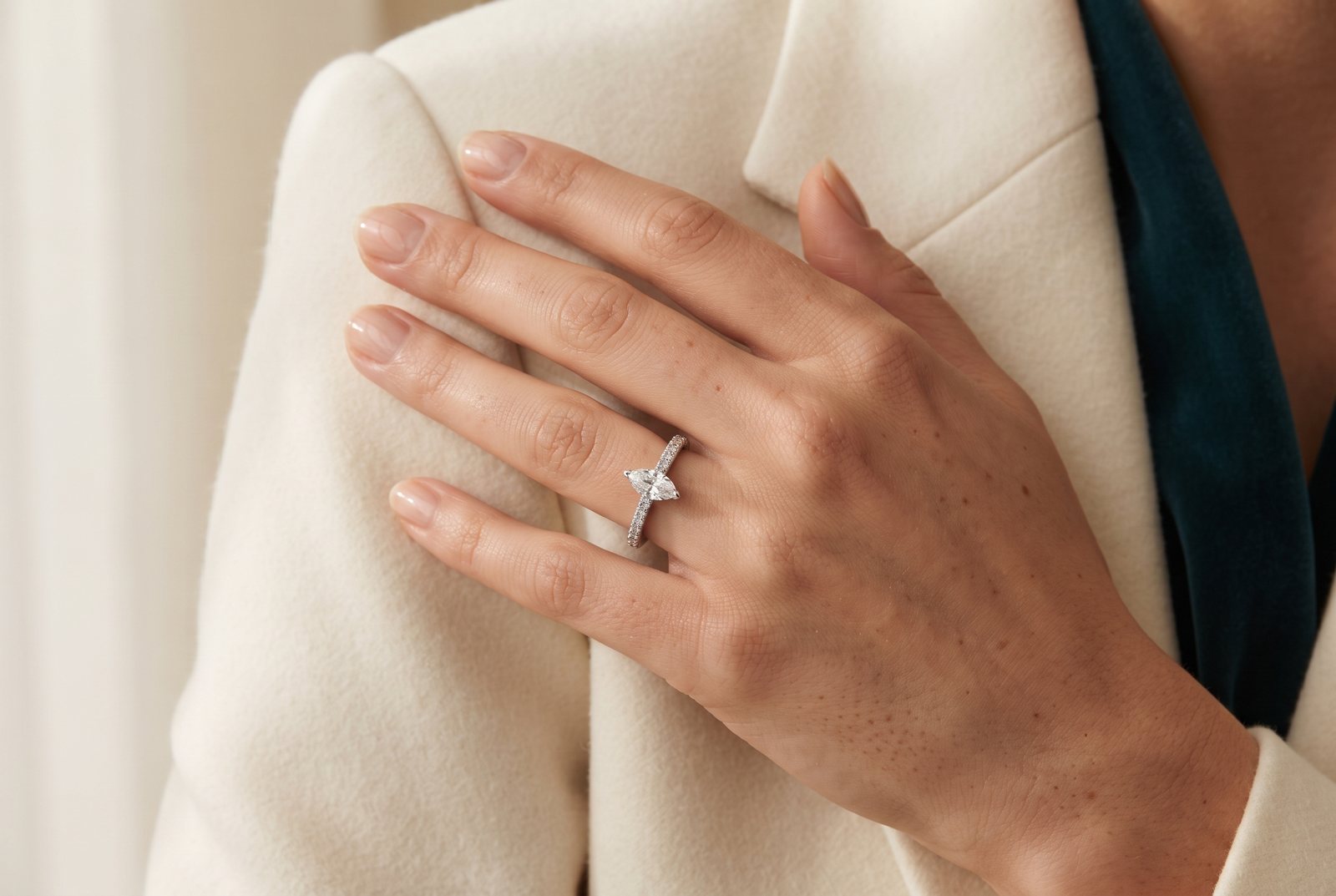
Short answer: The marquise cut is a long, graceful diamond shape pointed at both ends; it looks like an eye or the hull of a boat. It is one of the cuts that looks biggest for its carat, and it makes the finger look long and slim. When choosing one, check the length-to-width ratio (about 1.75–2.25), the “bow-tie” shadow across the centre of the stone, and that both pointed ends are protected by prongs.
The story of the marquise cut
Its name is said to come from a marquise who lived in 18th-century France; the shape is said to recall her smile. Another name for it is “navette”, French for a little boat. Whichever story you prefer, the marquise cut has been a symbol of grace and a striking presence for centuries.
Why marquise?
- It looks big: thanks to its long face, it looks clearly bigger than a round stone of the same carat. A 1-carat marquise is about 10 × 5 mm.
- It lengthens the finger: worn along the finger, it slims and lengthens it.
- It is different: it is not as common as round; a distinctive choice with character.
- It can cost less per carat: at the same carat and quality, it is usually more affordable than a round cut.
What to check when choosing a marquise stone
Length-to-width ratio
This is the ratio of the stone’s length to its width. In a classic marquise it is about 1.75–2.25; ratios close to 2 look most balanced. A shorter stone can look stubby, and a very long one too thin.
The bow-tie effect
A dark bow-tie shadow, where light does not return, can form across the centre of elongated shapes. In a well-cut stone this shadow is faint and pleasant; in a poor cut it is strong and dark. It is not written on the report; in well-cut stones with balanced proportions it stays faint.
Symmetry
The two ends should line up and the two wings should match. Even slight lopsidedness catches the eye at once in a marquise.
Protecting the points
The two sharp ends of a marquise are its most sensitive points. In a good setting, each end is wrapped and protected by a “V”-shaped prong. Can a diamond break?
Marquise ring designs
- Marquise solitaire: A single marquise stone; simple and striking.
- Marquise halo: Small diamonds around it make the stone look even bigger. What is a halo?
- Marquise side stones: A round or oval stone in the centre, with small marquises on the sides.
- Marquise rows: Half or full eternity bands made of small marquises side by side. Half eternity ring.
You can see the marquise designs made in our workshop in the gallery.
Vertical or horizontal? A marquise is usually worn along the finger (vertically), which lengthens it. A marquise set across the finger (horizontally) gives a modern, unusual look, and creates an interesting harmony especially with a wedding band.
Colour and clarity
Because the marquise is a brilliant-style cut, it hides small inclusions well; VS2 and eye-clean SI1 are good choices. Colour can show a little more at the ends; in white gold, G–H colour is a safe range. What does G colour mean?
Frequently asked questions
It is a long, narrow diamond shape pointed at both ends. It is one of the cuts that looks biggest for its carat and makes the finger look long. No. The marquise cut is much loved again in vintage and modern designs, and is used especially for side stones and half eternity bands. Its sharp ends are sensitive to knocks. With a setting that protects the ends with V-shaped prongs, it is suitable for everyday wear. A 1-carat marquise with classic proportions is about 10 × 5 mm, which makes it look clearly bigger than a round stone of the same carat.What does marquise cut mean?
Are marquise rings out of fashion?
Can a marquise-cut stone break?
How many mm is a 1-carat marquise?
Blog
Keep reading
Ring Guide
Can a Ring Be Resized Up or Down?
A ring's size can usually be changed by one or two sizes, but not on every style. We explain which rings can be adjusted…
4 min read
Ring Guide
Ring Design: Design Your Own Solitaire in 4 Steps
Designing your own ring is easier than you think: shape, carat, gold colour and quality. We explain how to design your solitaire in four…
4 min read
Ring Guide
Emerald Cut Solitaire: The Elegance of a Step Cut
The emerald cut is a step cut that shows off clarity and depth more than sparkle. We explain why clarity matters so much and…
3 min read
Ring Guide
How to Wear a Solitaire and a Wedding Band Together
How to wear a solitaire and a wedding band on the same finger in harmony: order, width, height and colour. We explain how to…
4 min read